On Degrowth and Defashion
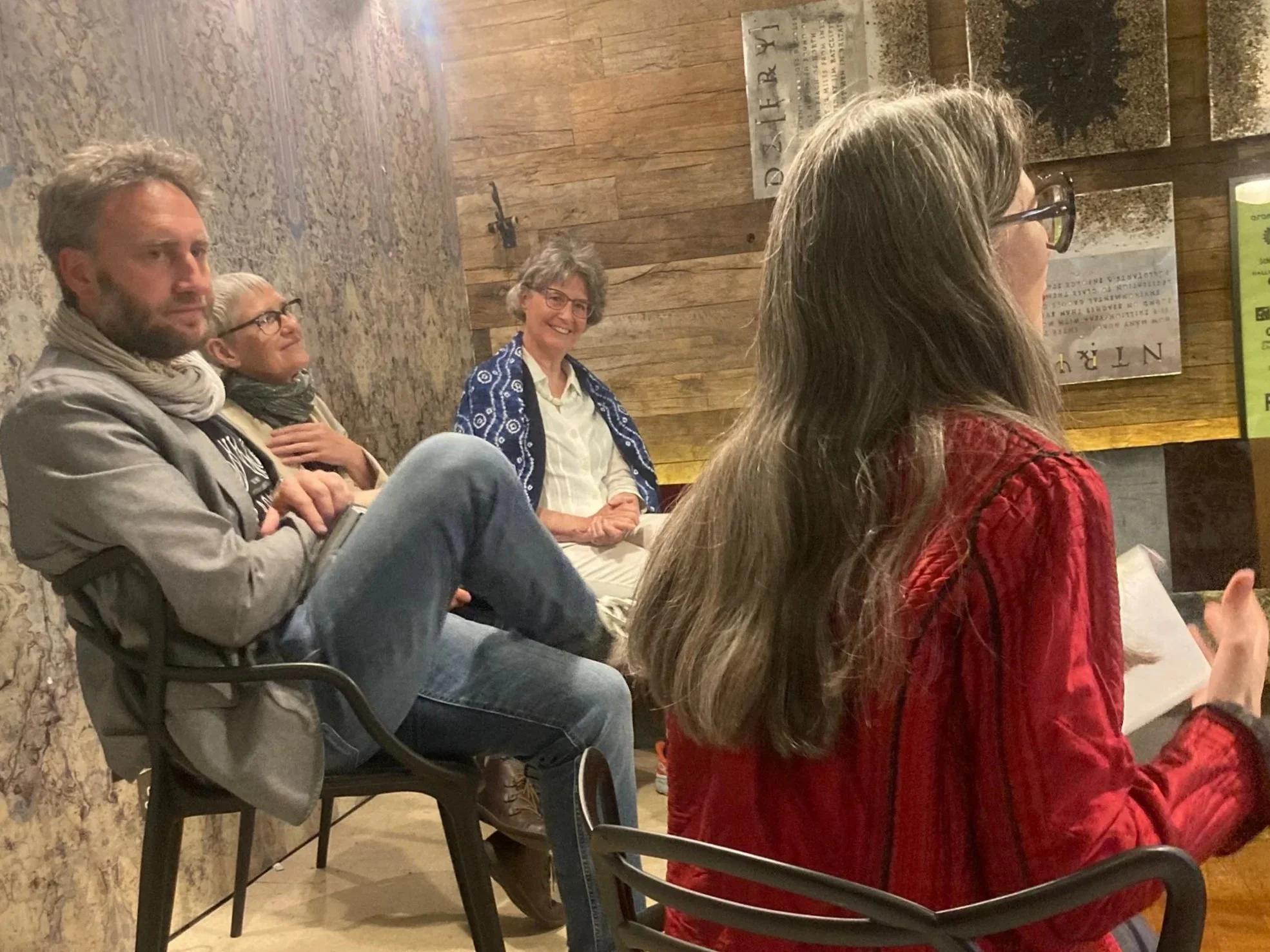
From left to right: Vincent Liegey, Anitra Nelson, Sandra Niessen. Foreground: Sara Arnold, Fashion Act Now. Picture: Bel Jacobs
By Bel Jacobs, Sandra Niessen and Sara Arnold. Originally published on Our Common Market. Find the original here.
On May 16th 2025, Fashion Act Now (FAN) and the Islington Climate Centre came together to host a launch event for the newly published Routledge Handbook of Degrowth, one stop on its European book tour. Edited by Anitra Nelson and Vincent Liegey, the handbook takes stock of ‘degrowth’ as ‘a concept and movement gaining increasing visibility’ with 35 chapter contributions, including a chapter that focuses on the concept of ‘defashion’, a term developed within the ranks of FAN. The event was designed to bring public attention to the intersection between ‘defashion’ and ‘degrowth’. Sara Arnold, the convenor of Fashion Act Now, moderated this conversation.
The book is available for free online via this link or to purchase via Routledge. Below is a shortened version of the transcript.
SARA: Serge Latouche, father of degrowth, said degrowth was NOT an economic project. Anitra, your work has looked at lots of elements of degrowth and taken this radical approach as well. Do you have something to add to that in terms of your own personal definition of degrowth?
ANITRA: I try to endorse Karl Marx’s approach and what I think are the foundations of degrowth. I had history in my undergraduate work in American studies. I became anti-economistic through that process and I ended up doing a major study on Mexico’s foreign public debt and that led me to do a PhD on Karl Marx’s concept of money.
Because in the women’s movement, in the peace movement, in the environmental movements, I’d become quite cynical about the way that economic systems worked and that gave me an opportunity to spend a few years looking at various ways that people look at money and economic frameworks. Through that, I came to a position of deciding that you couldn’t be ecologically sustainable and socially equitable through economics -- in particular, through the dynamics of money and the market. I take the position that you can’t achieve degrowth or eco-socialism or these kinds of bigger frameworks for living better with a strong and good relation with earth without dispensing with monetary frameworks or economics.
In the degrowth movement, a strong number of people moved from economics to conceptualising the ways we satisfy our basic needs through collective provisioning. These could be non-monetary ways of providing for ourselves, initially in households and then communities, deciding what they really need and how they will satisfy those needs, with as much local sufficiency as possible. Then you don’t need a market because you’ve decided what you need, and once these things have been produced, they come back to the people.
We spend a lot of time with state politics through decision-making and then we have a market where all the decision-making is done by a very small number of people, in very secretive and competitive ways. This absorbs a lot of human time and it’s ending up with outputs, with results, that are really negative in terms of the earth as well as people.
That’s my take. Although it’s only a minority within degrowth who would take that position, a lot of people question monetary frameworks and have chosen to use non-monetary frameworks for the ways they approach their own projects.
SARA: You came across Sandra’s opening provocation at the 2023 Defashioning Education conference in Berlin [1]. Why did you feel you needed to pursue this further?
ANITRA: Andrea, one of the authors on conviviality in the book, and I ended up at the conference and heard Sandra’s speech. I thought ‘this is absolutely amazing’. I have never come across a sector that has spoken and worked in eloquent and clear terms around reversing the way it’s functioning. The whole idea of fashion being put into a historical context, into a context in which indigenous people’s ways of approaching fashion integrated into a future … that’s really positive. It astounded me. When it came to the handbook, I thought we really want that.
SARA: Sandra, what brought you to the concept of ‘defashion’?
SANDRA: I was an anthropologist working alone. I was frustrated with the decline of the weaving arts in Sumatra, feeling angry and critical towards the global economy that was undermining what I saw as precious; angry at the fashion system for undermining other cultural systems of clothing and dress. In 2021, I was asked to speak at the first thematic event of Fashion Act Now (in “exploring the link between decolonisation and sustainability in fashion”, an online discussion between Extinction Rebellion co-founder Clare Farrell and Niessen)
Bel Jacobs, Sara Arnold and Clare Farrell of Fashion Act Now emerged from Extinction Rebellion to say ‘we need to give fashion its own due’. It was a huge issue and I was pulled in, to my great delight, because it’s all about solidarity. And making connections.
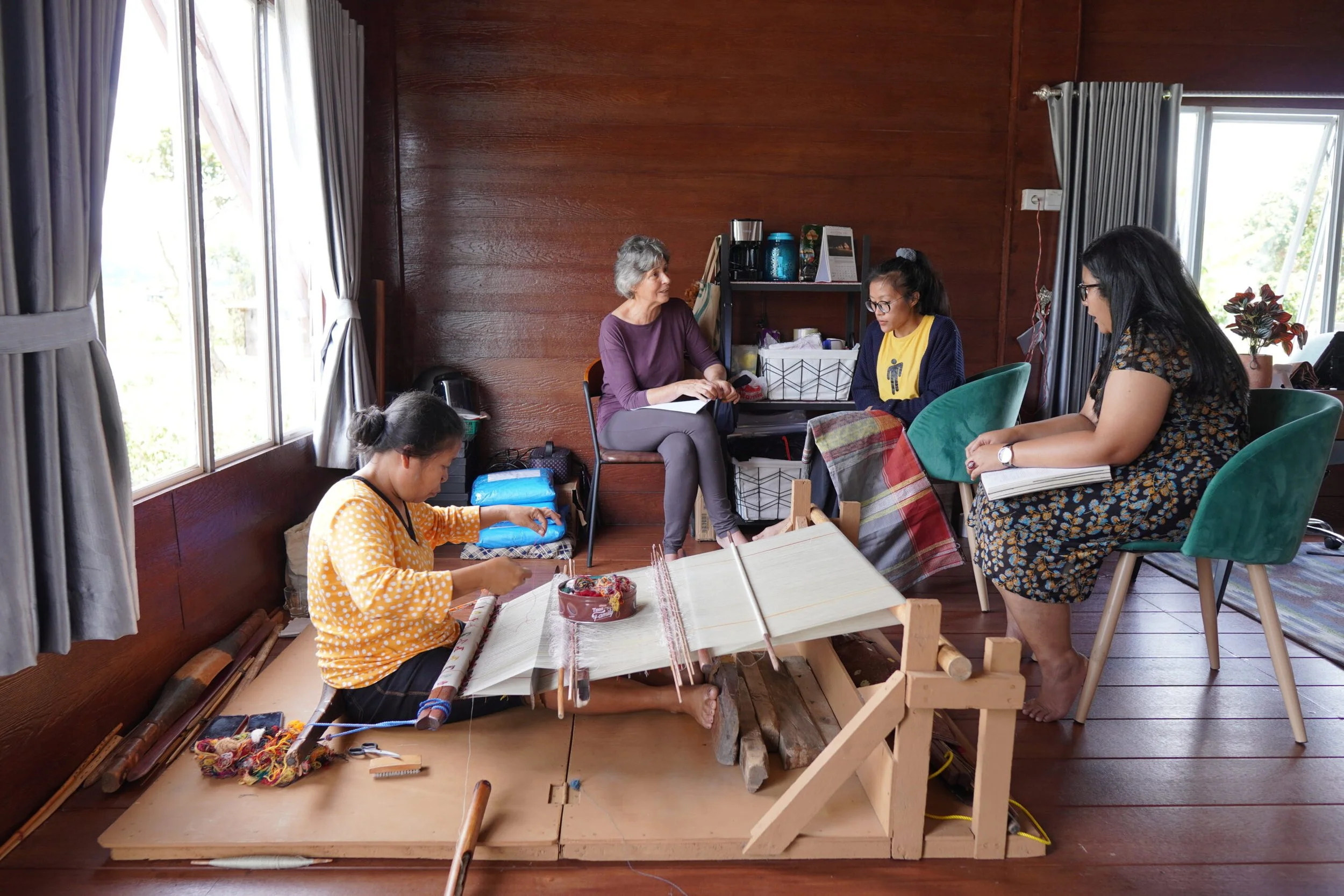
Sandra Niessen with Batak weavers in 2023. Picture: Ivan Panggabean.
The Handbook is not just an academic book; it’s a book about shifting not just our minds and our paradigms, our economic structures and our cultures. And I’m anxious to have the word ‘defashion’ become a household word. What Anitra has said so far really resonates. We’ve always asked in FAN: How are we going to situate ourselves as activists in the fashion domain? Everyone right now is working on reining fashion in, making it sustainable. How can we make it not destructive to wear clothes in this world?
Initially, within FAN we talked about the problem of paring down. We had a sense of a dark blanket over our heads and no more color, no more fancy parties, misery and drab. But I disagreed.
What has happened is that the industry has co-opted our creativity and design expertise. In North Sumatra, everybody who weaves is a designer; the separation between making and designing isn’t made. The person who does the craft is doing the invention. The separations, the divisions of labour, have come from capitalism and the industrial system. That’s part of what I saw was ruining the indigenous clothing system in North Sumatra. So I thought, let’s reverse it within FAN. We need to talk about dismantling the industry.
The ironic thing is most of the fashion people here today are working within schools of fashion, connected with the industry, and they’re the most critical minds. I love that. We all have to become ‘Trojan Mice’ [2]. We all have to go into our separate spheres and become Trojan Mice to change the system. That’s where networking and solidarity comes in.
When we talk about defashion within Fashion Act Now, we have to understand the implications of the industry on our thinking, on our day-to-day patterns, how we relate to dress, how we buy, sell and so on. We have to break that all down and get back to what it’s all about and that is what Anitra says: joy. The joy of living, the joy of clothes, the joy of creating without the imposition of the industry weighing us down.
Defashion is a liberating concept. I’d like the Degrowth Handbook to be called something like the Joy Handbook. To pull people in. When we talk about defashion, we’re not talking about the end of fashion. We’re talking about the beginning of the joy of fashion, of ‘doing’ with clothes and fibre; the heritage is so incredibly rich. There is so much knowledge out there. The fashion system has limited us, scrunched us down into this superficial thing of buying, wearing and throwing away - and we’re missing the joy of clothes. That’s why I wanted to jump in and sayI like what you’ve said so far. I like being here and I like everyone who’s here.
SARA: Vincent, I'm fascinated to know what you think of this idea of defashion and what Sandra's just presented, considering your understanding of the origins of degrowth.
VINCENT: I love defashion. I'm not an expert so I'm happy to learn more. And I was happy to review the text, to go deeper into defashion. Defashion is a type of metaphor for degrowth. You find so much in common. It's like degrowth – what we try to do for the whole society, you do it in a particular sector. I compare it with what's happening with technology, with low tech movement somehow.
When you question, in a radical way, from the roots, is how you've been de-possessed by the essence of the beauty of something. And while listening to what you were reading, you mentioned the commons and it reminds me of the history of degrowth in France, which goes much further. You may find a lot of what we call degrowth pioneers in history. You may find a lot of people doing degrowth by accident, all along the timeline of the history of Homo sapiens.
Actually, most of the principles behind degrowth were in most societies, groups, people of Homo sapiens in the last 300,000 years. Then, suddenly there was a terrible turnout with capitalism, and patriarchy, which turned into colonialism, where few people imposed brutality. It's well explained by Karl Polanyi, of Hungarian origin, historian of economics who used to live in UK, before moving to US and Canada, how the commons have been de-possessed from the people and expropriating the people from the commons, expropriating them also from common knowledge; the autonomy to be creative, to have solidarity. It's like they are selling things which are co-founded by humanity, making them less nice, less creative, and in making us buy them – the tragedy of the world we are in right now.
Defashion is bringing the same story through another pathway which is very enlightening and fruitful for the debate and the conversation. And you may find all the ingredients that we criticise in degrowth in this process. And also you may find all the liberating concepts of beautiful ideas. You may find degrowth towards defashioning and toward the re-appropriation of freedom, creativity, solidarity and enjoyment of life by doing beautiful things.
SARA: Sandra, I would love to know more about your field work with the Batak people, and how that relates to the commons and to this idea of defashion.
SANDRA: I remember sitting beside a weaver and she told me she had thought of a way to combine two patterns. In this society, patterns are named; they're worn in a particular way, they're given in a particular way, they're woven in a particular way, and so they're incredibly rooted. It's not easy to transform a pattern. And she was really excited. She said, I lie awake at night and I can't sleep because I'm so excited.
All their patterns, I see as emerging through time as layers of design, growing upon each other, creating this sort of image of Batak patterns, which are unique in all of the archipelago. I see design emergence as having to do with social structures, economic structures, technical idiom, local genius; it's community emergence. I see that as commons.
What it requires is a group of women who talk when they weave together, who go to each other and say, ‘How do you do that? I've just worked it out this way. What do you think? Do you think this will be accepted if I show this particular cloth in this way, in a ritual’ and so on. There's community happening all the time, every inch of the way, from planting the seeds of the cotton to giving the textiles a ritual gift, all the steps of the way are involving community.
So the word ‘commons’ was really exciting for me, because I thought, yeah, that's what I've been seeing, a commons.
And I watched this for decades, literally, and it occurred to me that that whole notion of a designer was actually kind of oppressive for them. Now there are even people coming in and saying they should be working with computer generated design based on their images. They don't have any notion of how design emerges in that society.
I see how our economic system has pushed these amazing technical weavers into a corner so that to live, they have to earn money, and they have to make a textile by the time the next market comes around.
There’s no more latitude for creativity or sharing. They've got debts, they've got kids. They have to pay for medicine. The price of indigenous textiles is very low. And so they're hamsters in the wheel running like mad, and it breaks down the commons. And I see the end of that particular design system, because it doesn't have the [freedom] to flourish.
That's why I'm so excited when I hear commons thinker David Bollier talk about how money is replaced by relationships [in the commons]. I want to honor that.
SARA: So often degrowth is talked about theoretically. And people ask, ‘Yeah, but can that ever really happen?’ I wonder if you could give us some examples of real existing degrowth.
VINCENT: We spoke about decolonising our imaginaries. And in particular for the Western world, it's about the economistic imaginary. We see the world only based on figures, in particular economic indicators and even more money. Mark Twain said, if you have a hammer in your head, all problems look like nails. Our hammer is the economy, and it's ridiculous, because there are already everywhere in our daily life, a very large dimension of degrowth principles happening. It’s just we don't see them.
And they are made even more invisible by these indicators. The most beautiful example is work. In most of European Western languages, we say that each work deserves a salary. It's a joke that the large majority of the most important tasks, what we do every day - the care economy, mostly made by women, are not paid and are invisible-ised - they don't exist because they're not paid for. They're not calculated into GDP growth and so on. So it's something which doesn’t exist.
Informal solidarities are everywhere in our daily life. In particular, the richest people are very supportive of each other. They apply a lot of beautiful, convivial, caring, solidarity principles in their everyday life - to each other. Even in a country like the UK, which is one of the most commodified societies in the world, if a child falls down in the street, people won't start to calculate how much money they will get. Everybody will naturally go to help.
And the society is much more complex. In Degrowth: A Vocabulary for a New Era, edited By Giacomo D'Alisa, Federico Demaria, Giorgos Kallis, all the concepts speaks about how we should dis-intoxicate ourselves from toxic concepts. Growth is a toxic concept we have – like an addiction. All the concepts, what we daily use in our western world, in our language, are making us blind to the one that really matters.
Degrowth is already here. Even in this highly commodified, capitalistic, patriarchal, technological, industrial society, we still have a large dimension of our daily life based on degrowth principles. And we are suffering because the main goal of capitalism is to destroy and to go into our intimacies, to totally colonise ourselves.
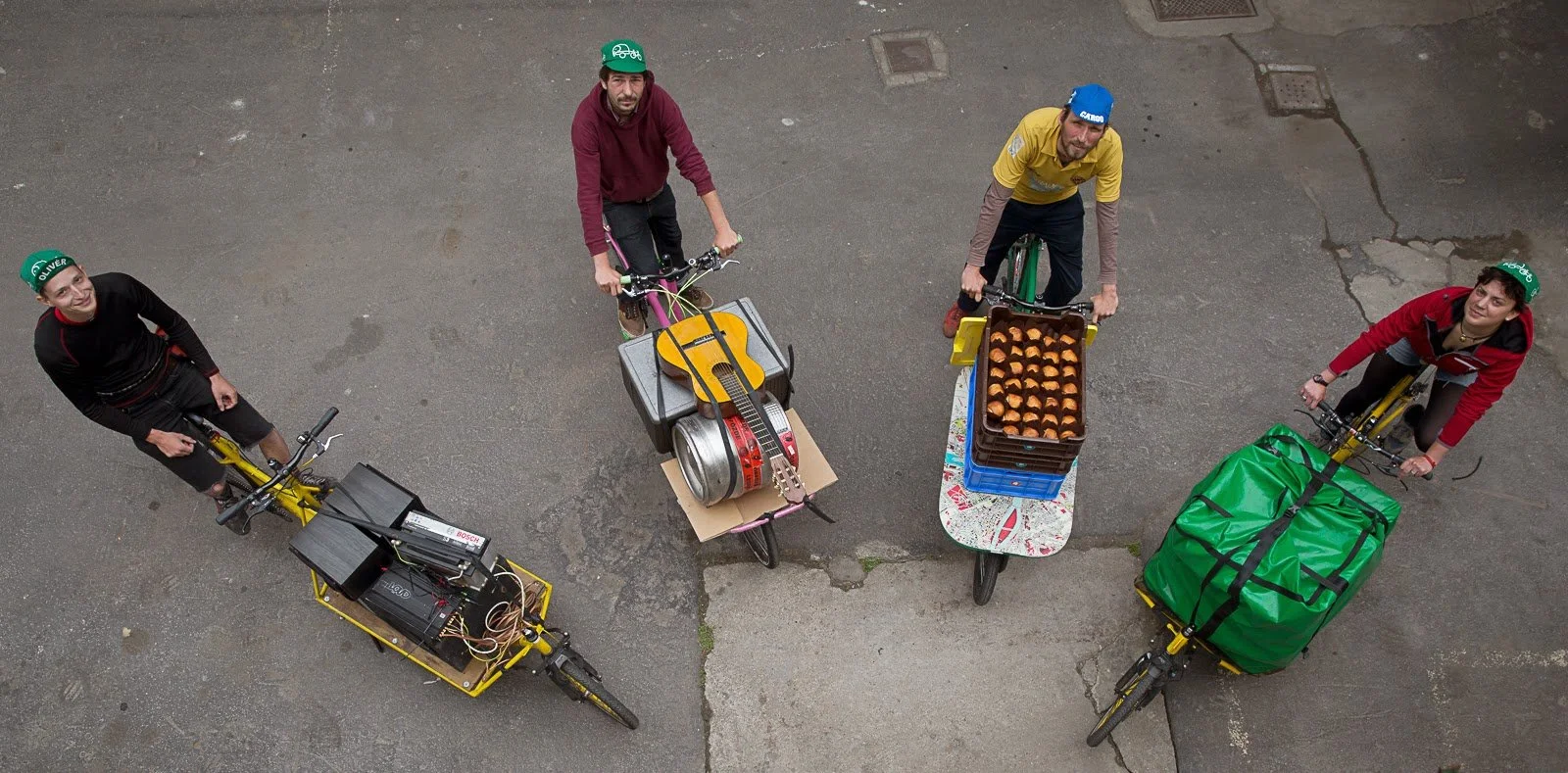
Cargobikes at Cargonomia. Photo: Cargonomia.
Anitra wants me to speak about Cargonomia, a cooperative in Budapest, co-founded with a group of friends more than 10 years ago. We celebrated the 10th anniversary last weekend with parties in Budapest. It brings together an organic farm, a bike shop, where we construct cargo bikes and bike trailers and logistics center, and we distribute our veggies with our cargo bikes.
It's a pretext to experiment and explore in our daily life, what degrowth could be. What is degrowth already? We mostly rely on a ‘no money’ type of system – reciprocity, gift economy. We are very lucky. In Budapest, you have a very large network of wonderful people, a lot of them are educated under the former system where the notion of commons was not defined that way, but they were educated somehow to deal with commons. They have free access to a lot of things, and they knew how to share and to protect the commons and so on. So you have a lot of open spaces in Budapest where people self-organize themselves and do a lot of wonderful things and share and celebrate in their daily life.
So I have the privilege and the honour and also the hard task and responsibility to be one of the coordinators of one of the projects of this ecosystem - and I would say one small cooperative among the millions, or maybe the billions of examples you may find all around the world.
The only danger in such a cooperative, there’s so much to do. So you start to be highly creative. You start to be autonomous and well connected with a lot of wonderful people who bring you a lot of tools and know how to network and so on. So somehow you fall down into another type of hubris - enjoying too many projects. But it's a lot of joy. And it's about being happy all day long and sharing. Everything is different from one day to the next. You may experience something different because the seasons are changing, the people are moving in, moving out, the projects are changing and so on.
SARA: I love that answer. People also ask us about examples of defashion or examples of fashion within commoning. And it's happening everywhere. It's all around us, but we don't see it.
SANDRA: I’d like to respond in two ways. I agree it is everywhere and it's also nowhere, because we're always dealing with that larger system. All of us here agree that we don't want clothing that destroys the earth and each other. But we're all wearing clothes that destroy the earth and each other. That's the problem. We don't want to use plastic, but we wanted to have a sandwich before we came here, so we bought something wrapped in plastic. This is the reality of our world. So we're creating alternative systems. Hopefully they'll become dominant, but in the meantime, we're dealing with what we've got.
Fashion Act Now has had a child, and it's called ‘Our Common Market’. There, we decided that in the activist community, relative to fashion, there were many people doing what they can to dismantle a harmful system or alter it. We don't believe it can be altered because it's too embedded in a deleterious economic system, so we're about creating alternatives, setting up commons, or at least highlighting them, giving them their due. They're always ignored. So we're trying to de-invisibilise the invisibilised through Our Common Market. It's a project with huge scope. We want it to have universal scope, even though we haven’t quite figured that out yet, but starting in the UK, mostly because most of our members are here.
We've been looking at how people organise to de-grow or avoid the fashion system and still be able to dress ourselves by mending circles. We've got a huge number of mending circles on our interactive map. We encourage people to set up communities, and then have our map of the world filled with communities. It's a way to be infectious. We hope there you'll find many communities. And also, we were just in ‘Defashion Dorset’ [3] this past weekend, where one of our members, Jenny Morrisetti, has set up a kind of a commons. It's not perfect; it's an experiment. You're feeling your way by doing it. You make the road by walking on it.
Jenny pulls together people who are experimenting with fiber, sheep and flax, and we have lectures, and we talk with each other, and we share information. So there's nothing that really presents itself as an alternative to the fashion system. Yet at the same time, it's all presenting itself as an alternative to the fashion system. It's just that we have to kind of shed this heavy weight on us that is the industry.
I think of that article that Naomi Klein just wrote with Astra Taylor called ‘End Times Fascism’[4]. These people have power because they have money; they don't care. They think they can live in a bubble. And that's what I mean about shedding. We do have alternative imaginaries to theirs and alternative systems, and dealing with that nexus between that alternative system that we're conceptualising, experimenting with, making headway on - and those oppressive structures that are getting in the way. We all need each other because we're all doing it in different ways, and tackling it from our own angle.
SARA: You quote in the book that 60.5% of Europeans surveyed express support for post growth and degrowth approaches. There's also been this big global survey that said 89% of people in various countries around the world want stronger climate action. So I want to talk about strategy, because with defashion, we've taken this dismantling strategy.
I know that, within degrowth there's tension between some strategies being labeled as escapist and others as strategies of resistance. I know it's not necessarily one thing or the other, but I want us to end by talking about strategy and also acknowledging our positionality here in the Global North, as people from the Global North - and how we navigate North/South relationships.
ANITRA: What Sandra was moving around in her discussion was politics, and I think the strong theme in the Handbook for Degrowth is that this is political, not economic - and it's only politics that is really going to get us there.
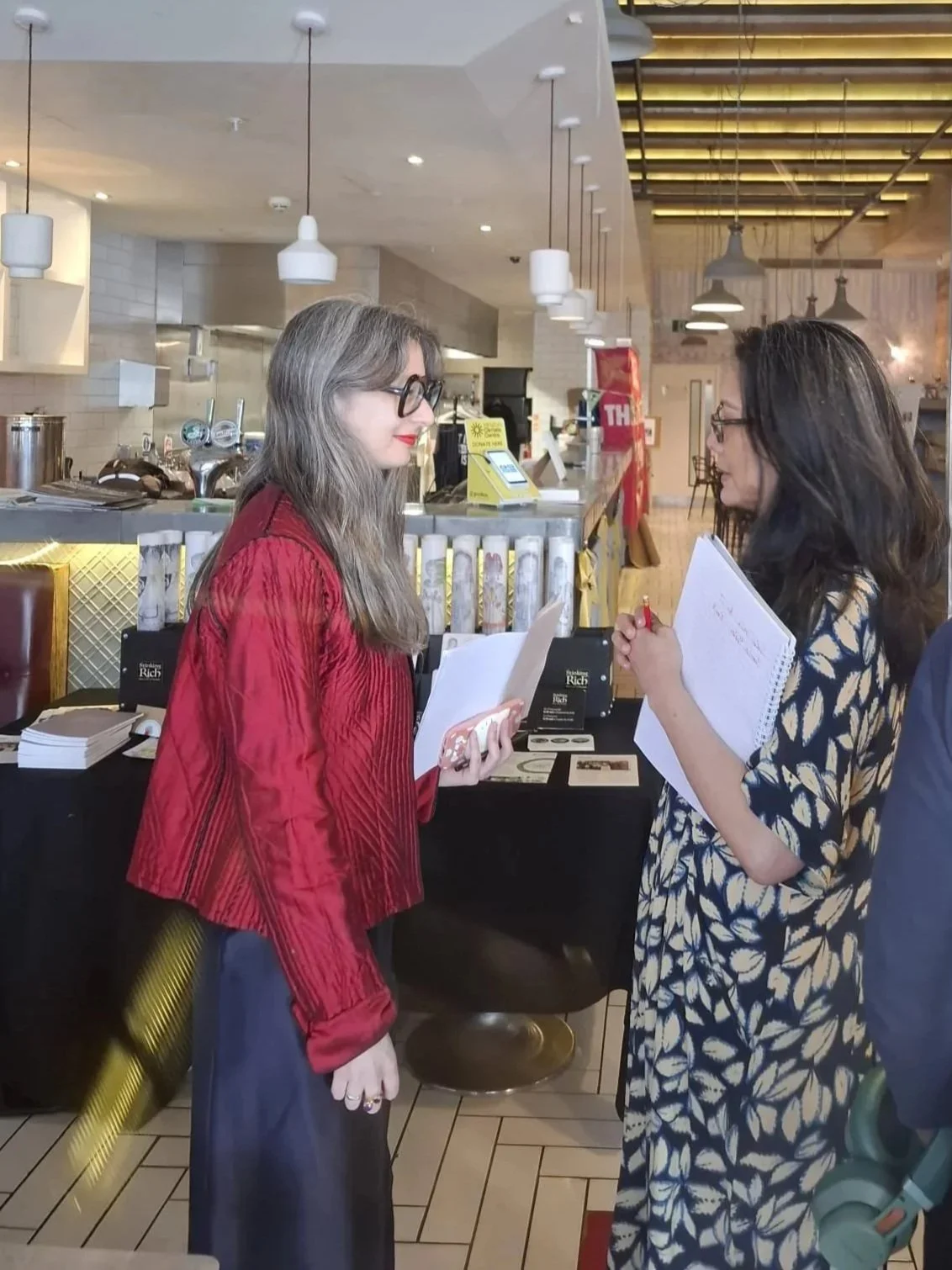
From left: Sara Arnold and Bel Jacobs
There can be so many of us wanting to do something different, but we have almost zilch power. You know, there's been a kind of arrogance in the Global North that we have democracies and what this means is that every three or four years, we can go and tick boxes for people who've become representatives that have put up candidates for elections.
It has required lots of money for them to do so, and a small number of people have selected those candidates. This is not us having any control over our lives at all, because everything that is out there in terms of shops and even the work that we do is all decided by a small number of people. Fashion Act Now is a very strong politics of raising our consciousnesses, collectively, listening and sharing and asking; how can we break this system?
In terms of practices like Cargonomia, they’re not just prefigurative. Terry Lane, who I work quite a lot with, an Australian degrowth and gift economy advocate, calls them pre-figurative hybrids which means working in this world, while at the same time trying as much as possible to represent how we want the world to be. We can see that as resistance on one side, as well as being really determined to move ahead and not simply resist. But we do have to resist, but not simply do that.
We need to be using more strategies like occupying – making the world completely different. My own bias is for grassroots. If we're going to have the revolutionary change we need - all of us, singly, individually and as communities - to internalise and be and act out those values. Therefore, it has to be a Grassroots Revolution. It can't be anything else. It can't come from top down.
[1] Digital Defashioning Education Conference, Berlin, 2023. https://www.udk-berlin.de/veranstaltung/de-fashioning-education/
[2] Term used by Tom Crisp, Falmouth University.
[3] Defashion Dorset, a two-day sustainable fashion initiative https://www.hawkersfarm.org/defashion-dorset-2025
[4] The rise of end times fascism, The Guardian, 13 April 2025. Naomi Klein and Astra Taylor, https://www.theguardian.com/us-news/ng-interactive/2025/apr/13/end-times-fascism-far-right-trump-musk